媒体数据在西方旅游学中的应用研究进展
|
张静(1996-),女,江苏靖江人,硕士研究生,研究方向为旅游管理。E-mail: 1016091909@qq.com |
收稿日期: 2022-04-28
修回日期: 2022-06-20
网络出版日期: 2022-08-26
基金资助
国家自然科学基金项目(41971171)
上海市哲学社会科学规划项目(2018BGL030)
Review on the application of media data in Western tourism studies
Received date: 2022-04-28
Revised date: 2022-06-20
Online published: 2022-08-26
随着Web2.0技术和社会化媒体的快速发展,媒体数据在旅游学术研究中得到了广泛应用。本文以Web of Science核心合集数据库中应用媒体数据开展旅游学术研究的外文文献为对象,评估媒体数据在西方旅游学研究中的应用情况。分析发现:媒体数据在旅游学研究中的应用经历了起始探索到快速发展两个阶段;媒体数据来源以网络社交媒体为主,以传统大众媒体为辅;媒体数据应用领域主要集中在旅游目的地形象与品牌特性、媒体在危机事件中扮演的角色、旅游行为足迹与旅游流、旅游需求/动机/偏好、游客体验与情绪分析等5个方面。已有研究在媒体数据应用上存在结论的普适性、媒体数据来源的代表性、媒体数据的真实有效性等局限,建议从旅游学相关数据库、旅游媒体大数据分析方法等方面不断建设与完善。
张静 , 卢松 , 段鹏霄 , 孙颖 , 胡凯霖 . 媒体数据在西方旅游学中的应用研究进展[J]. 中国生态旅游, 2022 , 12(3) : 374 -385 . DOI: 10.12342/zgstly.20220047
With the rapid development of Web2.0 technology and social media, data generated via social media has been widely used in tourism research. This paper evaluates the application of social media data in Western tourism research based on the literature in the core collection database of Web of Science. The results show that the application of social media data in tourism research has experienced two stages from initial exploration to rapid development. The main sources of data are from online social media, supplemented by traditional mass media. The application of social media data mainly focuses on five areas: the image and brand characteristics of tourist destinations, the role of media in crisis events, tourist behavior footprint and tourist flow, tourist demand/motivation/preference, tourist experience and emotion analysis. Existing studies have limitations in the application of media data, such as the generalizability of conclusions, the representativeness of social media data sources, and the reliability and validity of media data. It is suggested that future research should put emphasis on construction of tourism related database and the improvement of analytical methods regarding big data generated via tourism social media.
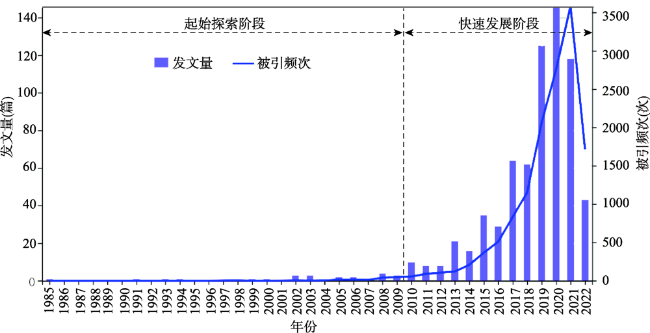
图1 1985年至今旅游类期刊中以媒体数据研究的年度发文量和被引频次趋势图Fig. 1 Trend of annual publication volume and citation frequency of research using media data in tourism journals from 1985 to present |
表1 旅游类期刊中以媒体数据研究的高被引文献引用信息统计(频次前十位)Tab. 1 Statistics of citation information of highly-cited literature using media data in tourism journals (Top ten by frequency) |
| 排名 | 第一作者 | 时间 | 被引频次 | 文献名称 | 来源期刊 |
|---|---|---|---|---|---|
| 1 | Daniel Leung | 2013 | 627 | Social media in tourism and hospitality: A literature review | Journal of Travel & Tourism Marketing |
| 2 | Stephanie Hays | 2013 | 390 | Social media as a destination marketing tool: Its use by national tourism organisations | Current Issues in Tourism |
| 3 | Yue Guo | 2017 | 360 | Mining meaning from online ratings and reviews: Tourist satisfaction analysis using latent dirichlet allocation | Tourism Management |
| 4 | Rob Law | 2014 | 312 | Progress on information and communication technologies in hospitality and tourism | International Journal of Contemporary Hospitality Management |
| 5 | Karen L. Xie | 2014 | 307 | The business value of online consumer reviews and management response to hotel performance | International Journal of Hospitality Management |
| 6 | Markus Schuckert | 2015 | 278 | Hospitality and tourism online reviews: Recent trends and future directions | Journal of Travel & Tourism Marketing |
| 7 | Svetlana Stepchenkova | 2013 | 224 | Visual destination images of Peru: Comparative content analysis of DMO and user-generated photography | Tourism Management |
| 8 | Estela Marine-Roig | 2015 | 176 | Tourism analytics with massive user-generated content: A case study of Barcelona | Journal of Destination Marketing & Management |
| 9 | Ali Reza Alaei | 2019 | 172 | Sentiment analysis in tourism: Capitalizing on big data | Journal of Travel Research |
| 10 | Ioannis S. Pantelidis | 2010 | 166 | Electronic meal experience: A content analysis of online restaurant comments | Cornell Hospitality Quarterly |
| [1] |
|
| [2] |
|
| [3] |
|
| [4] |
|
| [5] |
|
| [6] |
|
| [7] |
|
| [8] |
|
| [9] |
|
| [10] |
|
| [11] |
|
| [12] |
|
| [13] |
|
| [14] |
|
| [15] |
|
| [16] |
|
| [17] |
|
| [18] |
|
| [19] |
|
| [20] |
|
| [21] |
|
| [22] |
|
| [23] |
|
| [24] |
|
| [25] |
|
| [26] |
|
| [27] |
|
| [28] |
|
| [29] |
|
| [30] |
|
| [31] |
|
| [32] |
|
| [33] |
|
| [34] |
|
| [35] |
|
| [36] |
|
| [37] |
|
| [38] |
|
| [39] |
|
| [40] |
|
| [41] |
|
| [42] |
|
| [43] |
|
| [44] |
|
| [45] |
|
| [46] |
|
| [47] |
|
| [48] |
|
| [49] |
|
| [50] |
|
| [51] |
|
| [52] |
孟小峰, 慈祥. 大数据管理: 概念、技术与挑战[J]. 计算机研究与发展, 2013, 50(1): 146-169.
[
|
| [53] |
宋长青. 地理学研究范式的思考[J]. 地理科学进展, 2016, 35(1): 1-3.
[
|
| [54] |
王元卓, 靳小龙, 程学旗. 网络大数据: 现状与展望[J]. 计算机学报, 2013, 36(6): 1125-1138.
[
|
| [55] |
杨振山, 龙瀛, Douay N. 大数据对人文经济地理学研究的促进与局限[J]. 地理科学进展, 2015, 34(4): 410-417.
[
|
/
| 〈 |
|
〉 |