产业关联视角下中国住宿业碳排放结构路径研究
|
贺腊梅(1992-),女,博士,研究方向为可持续旅游、旅游能源消耗。E-mail: helamei@scu.edu.cn |
收稿日期: 2022-04-19
修回日期: 2022-08-06
网络出版日期: 2022-10-09
基金资助
国家自然科学基金青年项目(72102158)
A structural path analysis on carbon emissions from the accommodation industry in China from the perspective of industrial linkage
Received date: 2022-04-19
Revised date: 2022-08-06
Online published: 2022-10-09
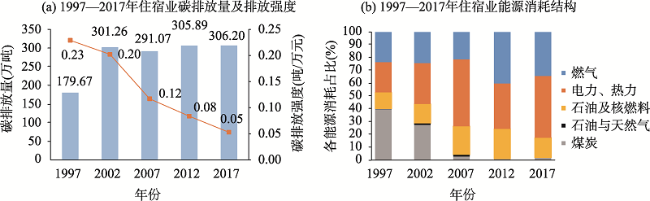
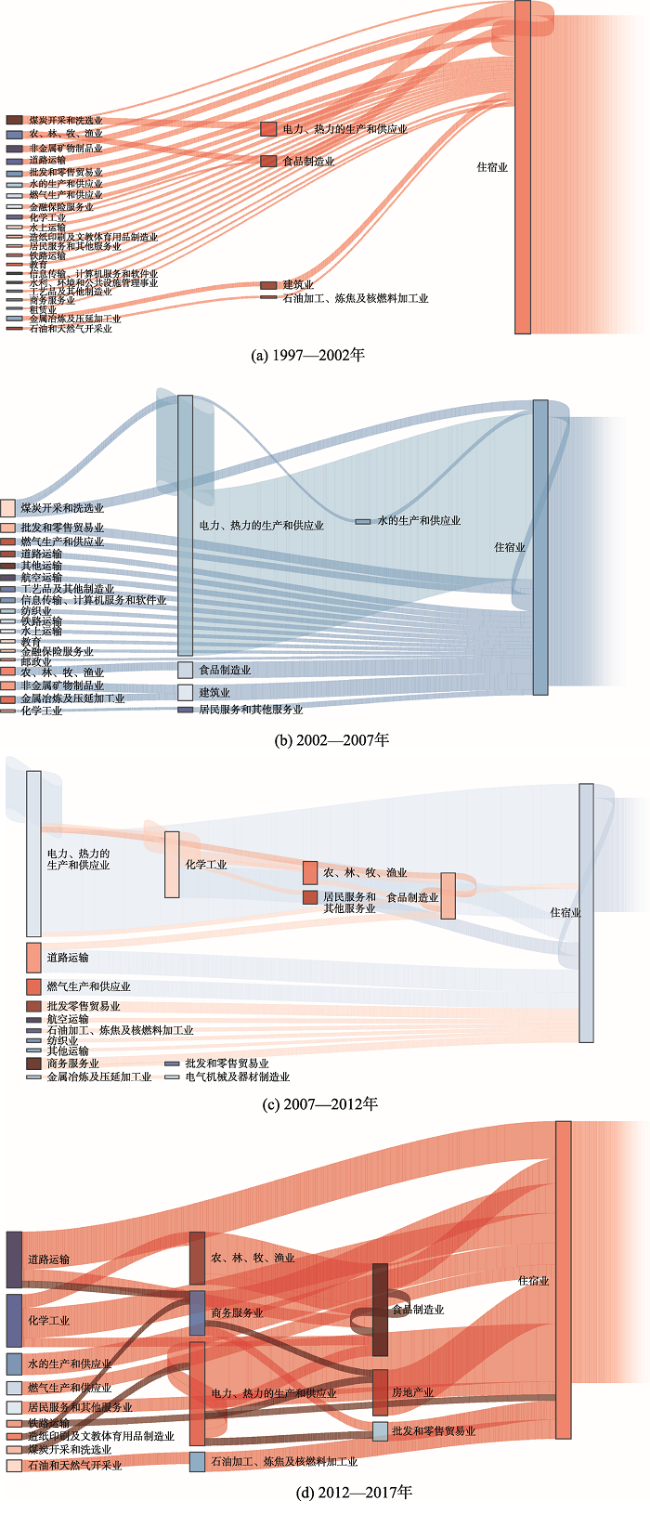
识别中国住宿业碳排放增长路径,是应对气候变化、精准制定旅游减排政策的关键。本研究从产业关联的视角出发,采用环境投入产出和结构路径分析方法,探究1997—2017年中国住宿业碳排放演变特征与影响住宿业碳排放变动的关键路径。结果表明:(1)研究期间中国住宿业碳排放量波动增长,但排放强度持续下降,电力和热力消耗是住宿业碳排放最主要的能源消耗类型。(2)最终需求引致的直接住宿业碳排放对住宿业全部碳排放量贡献始终较大,但住宿业消费中间产品投入引致的隐含碳排放量逐渐增多。(3)从供应链路径来看,"(上游供应部门)→食品制造业→住宿业→最终需求"与"(上游供应部门)→电力、热力的生产和供应业→住宿业→最终需求"是驱动中国住宿业碳排放变动的主要路径类型,上游供应部门涉及农林牧渔、道路运输、化学工业等部门。实现住宿业低碳发展应实施"源头减量、过程控制、末端治理"的综合治理战略,优化住宿业的中间产品投入结构,引导住宿业传统供应链向绿色供应链转型。
贺腊梅 , 查建平 , 陈淄涵 , 马思琦 . 产业关联视角下中国住宿业碳排放结构路径研究[J]. 中国生态旅游, 2022 , 12(4) : 646 -664 . DOI: 10.12342/zgstly.20220039
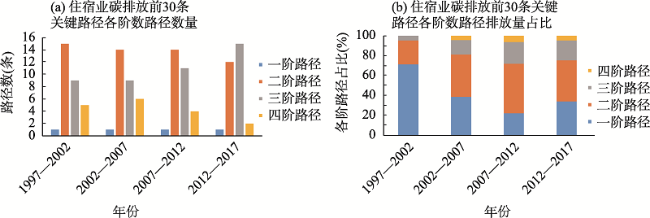
Identifying the key paths that drive changes in carbon emissions of accommodation industry in China is conducive to formulating the targeted mitigation policies. From the perspective of industrial linkage, this study adopts an environmental input-output model and structural path analysis model to build a framework, which can be used to explore the evolution characteristics of carbon emissions from the accommodation industry from 1997 to 2017 and further to excavate the key supply chain of carbon emissions changes. The results show that: (1) Carbon emission volume from the accommodation industry showed a fluctuating increase over the study period, but its intensity continues to decline, and electricity and heat consumption have become the most dominant type of energy consumption for the accommodation industry. (2) The first-order paths, i.e., direct carbon emissions caused by final demand, occupy an important position; the high-order path, which flows through more intermediate sectors, not only increases in number year by year but also generates gradually increasing emissions, which indicates that accommodation industry has a significant amount of embodied inter-sectoral carbon emissions by consuming intermediate products from other sectors. (3) "(Upstream supply sector)→food manufacturing industry→accommodation industry→final demand" and "(upstream supply sector)→production and supply of electricity and heat→accommodation industry→final demand" are the main types of key paths that affect accommodation industry’s carbon emissions, which involves upstream supply sectors such as agriculture, forestry, animal husbandry and fishery, road transport and chemical industry. To achieve low carbon development of the accommodation industry, a comprehensive management strategy of "source reduction, process control and end-of-pipe treatment" should be implemented, the input structure of intermediate products in the accommodation industry should be optimized, and the transformation from a traditional supply chain to a green supply chain of the accommodation industry should be encouraged.
表1 住宿业碳排放相关文献总结Tab. 1 Summary of literature on carbon emissions in the accommodation industry |
| 作者 | 研究目标 | 研究方法 | 主要发现 |
|---|---|---|---|
| 姚李忠等[25] | 以黄山西海饭店山岳型景区为案例酒店(2014—2018年) | 访谈法;碳足 迹法 | 案例酒店碳排放量为217.17~257.84 kg CO2/m2,年均碳排放量为236.79 kg CO2/m2 |
| 黄英[7] | 深圳、广州等地8家高星级酒店(2013年) | 问卷调查;基于投入产出的混合生命周期模型 | 间接碳足迹共占碳足迹总量的99.54% |
| 赵先超和朱翔[26] | 湖南省星级饭店(2000—2009年) | "自下而上"法 | 旅游住宿碳排放为5.1 Mt,占旅游业碳排放的24.19%;旅游住宿碳排放年均增加27.50%,略大于同期旅游交通增长速度 |
| 石培华和吴普[16] | 中国旅游星级饭店(2001—2008年) | "自下而上"法 | 住宿业CO2排放量为15.36 Mt,占旅游业全部排放量的29.92% |
| Filimonau等[18] | 位于英国多塞特郡普尔的两个城市酒店(2008年) | 生命周期能源分析 | 餐饮和洗衣服务对酒店的整体能源消耗和温室气体排放做出了高达30%~40%的贡献 |
| Chan和Lam [27] | 中国香港8家三星级、6家四星级和3家五星级酒店(1988—1997年) | 抽样调查;线性回归 | 1988—1997年酒店业用电产生的CO2略有减少;每个房间的每日排放量在14~37 kg不等 |
表2 各类型能源平均热值与折算标准煤系数Tab. 2 Average calorific value and carbon emission factor for each type of energy |
| 能源类型 | 单位 | 平均热值 | 折算标准煤系数 |
|---|---|---|---|
| 原煤 | 万吨(104 t) | 20 908千焦/千克(kJ/kg) | 0.7143 kgce/kg |
| 焦炭 | 万吨(104 t) | 28 435千焦/千克(kJ/kg) | 0.9714 kgce/kg |
| 原油 | 万吨(104 t) | 41 816千焦/千克(kJ/kg) | 1.4286 kgce/kg |
| 汽油 | 万吨(104 t) | 43 070千焦/千克(kJ/kg) | 1.4714 kgce/kg |
| 煤油 | 万吨(104 t) | 43 070千焦/千克(kJ/kg) | 1.4714 kgce/kg |
| 柴油 | 万吨(104 t) | 42 652千焦/千克(kJ/kg) | 1.4571 kgce/kg |
| 燃料油 | 万吨(104 t) | 41 816千焦/千克(kJ/kg) | 1.4286 kgce/kg |
| 液化石油气 | 万吨(104 t) | 50 179千焦/千克(kJ/kg) | 1.7143 kgce/kg |
| 炼厂干气 | 万吨(104 t) | 46 055千焦/千克(kJ/kg) | 1.5714 kgce/kg |
| 天然气 | 亿立方米(108 m3) | 38 931千焦/千克(kJ/kg) | 1.3300 kgce/m3 |
表8 附录 投入产出表部门调整及划分 |
| 序号 | 部门名称 | 序号 | 部门名称 |
|---|---|---|---|
| 1 | 农、林、牧、渔业 | 27 | 建筑业 |
| 2 | 煤炭开采和洗选业 | 28 | 铁路运输 |
| 3 | 石油和天然气开采业 | 29 | 道路运输 |
| 4 | 金属矿采选业 | 30 | 水上运输业 |
| 5 | 非金属矿及其他矿采选业 | 31 | 航空运输 |
| 6 | 食品制造业 | 32 | 其他运输 |
| 7 | 烟草制品业 | 33 | 邮政业 |
| 8 | 纺织业 | 34 | 信息传输、计算机服务和软件业 |
| 9 | 纺织服装鞋帽皮革羽绒及其制品业 | 35 | 批发和零售贸易业 |
| 10 | 木材加工及家具制造业 | 36 | 住宿业 |
| 11 | 造纸印刷及文教体育用品制造业 | 37 | 餐饮业 |
| 12 | 石油加工、炼焦及核燃料加工业 | 38 | 金融保险服务业 |
| 13 | 化学工业 | 39 | 房地产业 |
| 14 | 非金属矿物制品业 | 40 | 租赁业 |
| 15 | 金属冶炼及压延加工业 | 41 | 商务服务业 |
| 16 | 金属制品业 | 42 | 研究与试验发展业 |
| 17 | 通用、专用设备制造业 | 43 | 综合技术服务业 |
| 18 | 交通运输设备制造业 | 44 | 水利、环境和公共设施管理事业 |
| 19 | 电气机械及器材制造业 | 45 | 居民服务和其他服务业 |
| 20 | 通讯设备、计算机及其他电子设备制造业 | 46 | 教育 |
| 21 | 仪器仪表及文化办公用机械制造业 | 47 | 卫生、社会保障和社会福利业 |
| 22 | 工艺品及其他制造业 | 48 | 文化艺术 |
| 23 | 废品废料 | 49 | 体育事业 |
| 24 | 电力、热力的生产和供应业 | 50 | 娱乐业 |
| 25 | 燃气生产和供应业 | 51 | 公共管理和社会组织 |
| 26 | 水的生产和供应业 |
| [1] |
|
| [2] |
World Tourism Organization UNWTO, the United Nations Environment Programme UNEP and the World Meteorological Organization (WMO). Climate Change and Tourism-Responding to Global Challenges[R/OL]. (2008-06-05).
|
| [3] |
|
| [4] |
|
| [5] |
刘益. 中国酒店业能源消耗水平与低碳化经营路径分析[J]. 旅游学刊, 2012, 27(1): 83-90.
[
|
| [6] |
高兴, 张殿光, 袁杰, 等. 我国酒店业餐饮服务全过程能耗现状分析[J]. 建筑科学, 2007, 23(4): 40-44, 69.
[
|
| [7] |
黄英. 酒店碳足迹测算研究综述[J]. 生态经济, 2015, 31(10): 95-102.
[
|
| [8] |
李旭, 秦耀辰, 张丽君, 等. 住宿业碳排放研究进展[J]. 地理科学进展, 2013, 32(3): 408-415.
[
|
| [9] |
黄崎, 康建成, 黄晨皓. 酒店业碳排放评估与节能减排潜力研究[J]. 资源科学, 2014, 36(5): 1013-1020.
[
|
| [10] |
查建平, 谭庭, 李园园, 等. 中国旅游产业关联效应及其分解: 基于投入产出分析的实证研究[J]. 山西财经大学学报, 2018, 40(4): 62-74.
[
|
| [11] |
|
| [12] |
|
| [13] |
|
| [14] |
|
| [15] |
|
| [16] |
石培华, 吴普. 中国旅游业能源消耗与CO2排放量的初步估算[J]. 地理学报, 2011, 66(2): 235-243.
[
|
| [17] |
|
| [18] |
|
| [19] |
陶玉国, 张红霞. 江苏旅游能耗和碳排放估算研究[J]. 南京社会科学, 2011(8): 151-156.
|
| [20] |
吴普, 田密. 海口市旅游业直接能源需求与CO2排放的定量测算[J]. 资源科学, 2014, 36(12): 2508-2516.
[
|
| [21] |
|
| [22] |
|
| [23] |
|
| [24] |
查建平, 谭庭, 钱醒豹, 等. 中国旅游业碳排放及其驱动因素分解[J]. 系统工程, 2018, 36(5): 23-36.
[
|
| [25] |
姚李忠, 王中华, 徐圣友. 山岳型酒店能源强度与碳排放特征研究: 以黄山西海饭店为例[J]. 地理科学, 2020, 40(6): 965-972.
[
|
| [26] |
赵先超, 朱翔. 湖南省旅游业碳排放的初步估算及脱钩效应分析[J]. 世界地理研究, 2013, 22(1): 166-175, 129.
[
|
| [27] |
|
| [28] |
唐承财, 钟林生, 成升魁. 旅游业碳排放研究进展[J]. 地理科学进展, 2012, 31(4): 451-460.
[
|
| [29] |
李姝晓, 程锦红, 程占红. 全球气候变化背景下低碳旅游研究进展及可视化分析[J]. 中国生态旅游, 2021, 11(1): 141-158.
[
|
| [30] |
张红霞, 苏勤, 陶玉国. 住宿业节能减碳研究进展及启示[J]. 地理科学进展, 2017, 36(6): 774-783.
[
|
| [31] |
高兴, 袁杰, 李文霞, 等. 酒店主要产品服务经济-能源-环境系统分析[J]. 中国人口·资源与环境, 2007, 17(4): 81-86.
[
|
| [32] |
|
| [33] |
|
| [34] |
|
| [35] |
|
| [36] |
|
| [37] |
阳立高, 陈亭亭, 谢锐, 等. 最终需求影响中国要素收入分配的关键路径研究[J]. 中国软科学, 2020(9): 162-174.
[
|
| [38] |
|
| [39] |
|
| [40] |
国家统计局. 生活性服务业统计分类(2019)[S/OL]. [2019-04-01].
[ National Bureau of Statistics. Statistical Classification of Subsistence Services (2019)[S/OL].[2019-04-01]http://www.stats.gov.cn/tjsj/tjbz/201904/t20190417_1660043.html.]
|
| [41] |
|
| [42] |
Intergovernmental Panel on Climate Change. Revised 1996 IPCC Guidelines for National Greenhouse Gas Inventories[R/OL]. (1997-08-18).
|
| [43] |
|
| [44] |
|
| [45] |
张炎治, 冯颖, 张磊. 中国碳排放增长的多层递进动因: 基于SDA和SPD的实证研究[J]. 资源科学, 2021, 43(6): 1153-1165.
[
|
| [46] |
|
| [47] |
|
| [48] |
籍艳丽, 郜元兴. 二氧化碳排放强度的实证研究[J]. 统计研究, 2011, 28(7): 37-44.
[
|
| [49] |
刘佳, 陈兴鹏, 张子龙. 中国旅游业碳排放特征及其因素分解[J]. 资源与产业, 2017, 19(3): 67-75.
[
|
| [50] |
胡林林, 贾俊松, 周秀. 我国旅游住宿碳排放时空特征及其主要影响因素[J]. 中南林业科技大学学报, 2015, 35(3): 123-128.
[
|
| [51] |
程占红, 程锦红, 张奥佳. 五台山景区游客低碳旅游认知及影响因素研究[J]. 旅游学刊, 2018, 33(3): 50-60.
[
|
| [52] |
|
| [53] |
|
| [54] |
|
| [55] |
|
| [56] |
黄崎, 康建成, 张建业. 酒店业碳排放基准线的构建与节能减排实证研究[J]. 旅游科学, 2017, 31(4): 79-94.
[
|
/
| 〈 |
|
〉 |