2000—2020年北京市生态游憩空间分布格局演变
|
王甫园(1988-),男,博士,副研究员,研究方向为旅游地理、旅游生态学。E-mail: wangfy@igsnrr.ac.cn |
收稿日期: 2023-08-29
修回日期: 2023-12-15
网络出版日期: 2024-02-06
基金资助
国家自然科学基金面上项目(42371253)
国家自然科学基金青年项目(41901181)
Evolution of ecological recreation space distribution pattern in Beijing from 2000 to 2020
Received date: 2023-08-29
Revised date: 2023-12-15
Online published: 2024-02-06
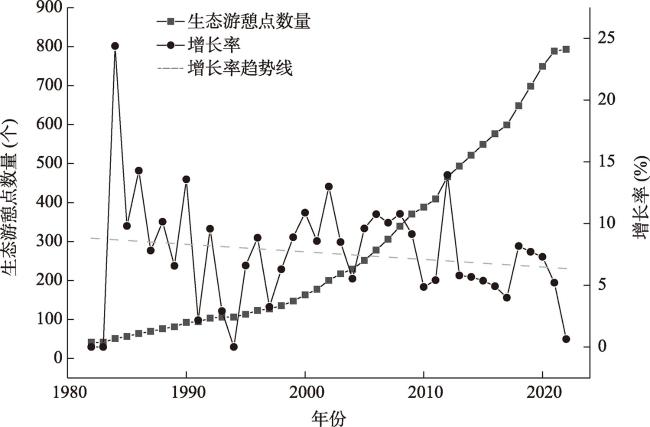
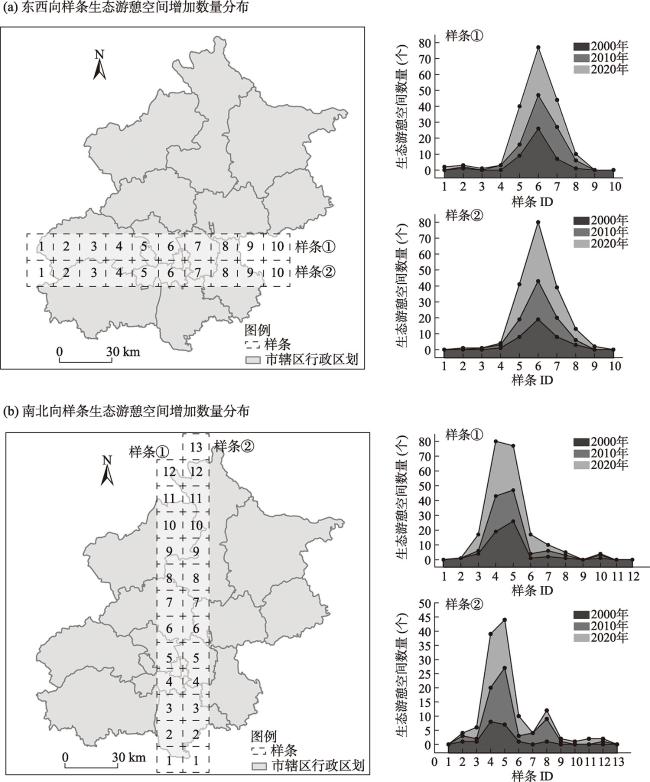
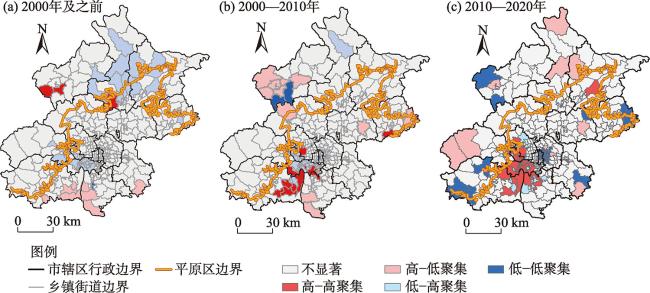
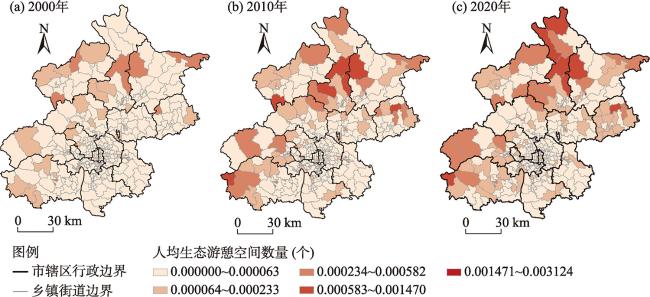
生态游憩空间是城市居民福祉的重要保障。在大都市区宜居化、生态化的发展趋势以及居民游憩活动区域化的背景下,研究大都市区生态游憩空间统筹布局的优化具有重要意义。本研究探讨了2000—2020年北京市生态游憩空间的分布特征、时空演化和关联因素,得到以下结论:(1)2000—2020年北京市生态游憩空间时空演化模式经历“中心城区集聚-山区集聚-环中心城区扩展”3个阶段,整体格局从“单核集聚”逐渐向“单核多中心”“域面连绵”演化,形成了中心城区和平原区新城新区集聚、山区低密度的生态游憩空间分布态势;(2)生态游憩空间的分布重心变化沿东北-东南走向移动,分布格局演化经历了先扩散后集中的过程,东西走向生态游憩空间数量增长的极化效应更突出,而南北走向生态游憩空间数量增长的分布相对均衡且具有多中心特征;(3)生态游憩空间的分布与高程、水系、交通、生态空间有依存关系,而人口需求和规划政策驱动北京市生态游憩空间数量增长和扩展。本研究启示大都市区从区域整体性视角进一步统筹生态游憩空间建设和布局,优化城市生态游憩空间分布,推进城市国土空间结构优化和居民福祉提升。
王甫园 , 张之羽 . 2000—2020年北京市生态游憩空间分布格局演变[J]. 中国生态旅游, 2023 , 13(6) : 1077 -1095 . DOI: 10.12342/zgstly.20230136
Ecological recreation space plays a pivotal role in ensuring the well-being of urban inhabitants. Given the increasing emphasis on livability and ecological development in metropolitan areas, coupled with the regionalization of residents’ recreation activities, it becomes imperative to delve into the optimization of the comprehensive layout of ecological recreation spaces. This paper examines the distribution patterns, temporal evolution, and influencing factors of ecological recreation spaces in Beijing between 2000 and 2020. The following conclusions are drawn: (1) From 2000 to 2020, the spatiotemporal evolution of ecological recreation space in Beijing was characterized by three distinct phases: initial central urban area aggregation, subsequent mountain-based aggregation, and final expansion around these central urban areas. The overarching pattern transitioned from a singular-core aggregation to a dual-core model with multiple centers, culminating in a face-shaped continuity. This resulted in the distribution characteristics of ecological recreation spaces in the central urban area and new cities within plain areas being concentrated, while the mountainous areas have low-density spaces. (2) The distribution center of ecological recreation spaces has shifted along the northeast-southeast direction, experiencing a process of initial dispersion followed by concentration. The polarized effect of the increase in the number of ecological recreation spaces in the east-west orientation is more prominent, while the distribution of the increase in the number of ecological recreation spaces in the north-south orientation is relatively balanced and has multi-center characteristics. (3) The distribution of ecological recreation spaces within urban areas has a dependent relationship with elevation, water systems, transportation infrastructure, and ecological space, yet population demand and planning policies play pivotal roles in driving the increase in the number and expansion of these spaces in Beijing. This study suggests that metropolitan regions should enhance the coordination of ecological recreation space construction and design from a comprehensive regional perspective. It emphasizes the importance of optimizing the distribution of urban ecological recreation spaces, thereby promoting the refinement of urban territorial spatial structures and enhancing residents’ well-being.
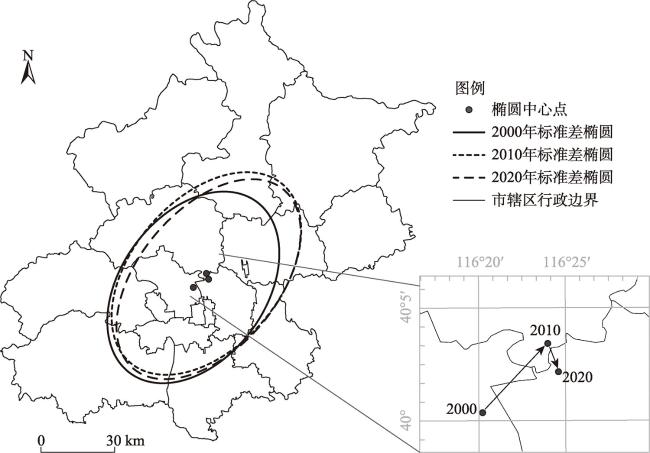
图4 北京市2000、2010、2020年生态游憩空间标准差椭圆分析结果注:该图基于自然资源部标准地图服务网站下载的审图号为GS(2019)1822 号的标准地图制作,底图无修改。 Fig. 4 Standard deviation ellipse analytical results of ecological recreation spaces in Beijing in 2000, 2010, and 2020 |
表1 标准差椭圆相关参数Tab. 1 Parameters of standard deviation ellipse |
| 年份 | 2000年 | 2010年 | 2020年 |
|---|---|---|---|
| 扁率 | 0.68 | 0.63 | 0.59 |
| 椭圆面积(km²) | 4026.50 | 4540.80 | 4242.27 |
| 旋转角(°) | 36.46 | 40.49 | 39.97 |
表2 北京市生态游憩空间时空演化模式Tab. 2 Spatial and temporal evolution pattern of ecological recreation space in Beijing |
表3 20世纪80年代以来北京市区域规划中生态游憩空间建设相关内容及对应建设模式Tab. 3 The relevant content and corresponding construction patterns of ecological recreation space construction in Beijing regional planning since the 1980s |
| 规划名称 | 时间 | 与生态游憩空间建设相关内容 | 阶段建设模式及特点 |
|---|---|---|---|
| 《北京城市建设总体 规划方案》 | 1982年 | 积极开发山区,注意生态环境和自然资源的保护,大力造林绿化,因地制宜发展林牧副业、旅游业和符合山区特点的乡镇企业[38] | 中心城区集聚、山区少量开发模式,以北京市旧城改建中的历史名园、城市公园为主,山区游憩开发处于起步阶段 |
| 《北京城市总体规划(1991年—2010年)》 | 1992年 | 坚持经济建设、城乡建设、环境建设同步规划、同步实施、同步发展,保护和改善首都生态环境、加强古都风貌和历史文化名城保护[39] | |
| 《北京城市总体规划(2004年—2020年)》 | 2004年 | 在山区和平原应当保护景观资源,推广生态旅游,在中心城及其城乡结合区则应当控制建设规模,加强绿地等生态基础设施建设[40] | 西山地区及其余部分山区集聚开发模式,生态游憩空间建设重心朝西北部山区移动 |
| 《北京城市总体规划(2016年—2035年)》 | 2017年 | 在北京市域范围内形成“一核一主一副、两轴多点一区”的城市空间结构,着力改变单中心集聚的发展模式,构建北京新的城市发展格局;通过腾退还绿、疏解建绿、见缝插绿等途径,增加公园绿地、小微绿地、活动广场,为人民群众提供更多游憩场所[33] | “环中心城区”平原区扩展模式,包含城市副中心在内的环中心城区地区成为扩张热点 |
| 《北京市第二道绿化隔离地区减量提质规划(2021年—2035年)》 | 2023年 | 到2035年,北京市第二道绿化隔离地区建成世界级郊野公园环,形成“一环九群百园”的公园图景[41] |
| [1] |
李华. 上海城市生态游憩空间格局及其优化研究[J]. 经济地理, 2014, 34(1): 174-180.
[
|
| [2] |
张书颖, 刘家明, 朱鹤, 等. 国内外城市生态游憩空间研究进展[J]. 人文地理, 2019, 34(5): 15-25, 35.
[
|
| [3] |
宋瑞, 牛青翠, 朱玲, 等. 基于绿地8类感知属性法的复愈性环境构建研究: 以宝鸡市人民公园为例[J]. 中国园林, 2018, 34(S1): 110-114.
[
|
| [4] |
李想, 雷硕, 冯骥, 等. 北京市绿地生态系统文化服务功能价值评估[J]. 干旱区资源与环境, 2019, 33(6): 33-39.
[
|
| [5] |
彭婉婷, 刘文倩, 蔡文博, 等. 基于参与式制图的城市保护地生态系统文化服务价值评价: 以上海共青森林公园为例[J]. 应用生态学报, 2019, 30(2): 439-448.
[
|
| [6] |
|
| [7] |
安淇, 肖华斌, 张培元, 等. 国外城市绿地生态系统文化服务研究进展[J]. 山东建筑大学学报, 2020, 35(1): 76-82, 96.
[
|
| [8] |
李玏, 刘家明, 宋涛, 等. 北京市绿带游憩空间分布特征及其成因[J]. 地理研究, 2015, 34(8): 1507-1521.
[
|
| [9] |
|
| [10] |
王甫园, 王开泳, 虞虎, 等. 珠三角城市群生态游憩空间分异特征及关联性因素[J]. 地理研究, 2020, 39(9): 2148-2164.
[
|
| [11] |
王甫园, 王开泳, 郑鑫, 等. 珠三角城市群生态空间游憩利用扩展格局及影响因素[J]. 生态学报, 2021, 41(17): 7049-7062.
[
|
| [12] |
唐明贵, 胡静, 吕丽, 等. 贵州省生态游憩空间时空演化特征及其驱动因素[J]. 生态学报, 2022, 42(21): 8594-8604.
[
|
| [13] |
王甫园, 王开泳, 刘汉初. 珠三角城市群生态空间游憩服务供需匹配性评价与成因分析: 基于改进的两步移动搜寻法[J]. 生态学报, 2020, 40(11): 3622-3633.
[
|
| [14] |
|
| [15] |
|
| [16] |
|
| [17] |
|
| [18] |
|
| [19] |
|
| [20] |
|
| [21] |
杨友宝, 李琪. 基于POI数据的城市公共游憩空间分布格局及其形成机制研究: 以长沙市主城区为例[J]. 现代城市研究, 2021, 36(3): 91-97.
[
|
| [22] |
|
| [23] |
|
| [24] |
曾刚. 都市圈旅游空间特征、演化与机理: 评《都市圈旅游空间研究》[J]. 中国生态旅游, 2022, 12(1): 184-185.
[
|
| [25] |
北京市统计局, 国家统计局北京调查总队. 北京区域统计年鉴2021[M]. 北京: 中国统计出版社, 2021.
[ Beijing Bureau of Statistics, National Bureau of Statistics Beijing Survey Team. Beijing Regional Statistical Yearbook 2021[M]. Beijing: China Statistics Press, 2021. ]
|
| [26] |
北京市第七次全国人口普查领导小组办公室, 北京市统计局. 北京市人口普查年鉴:2020[M]. 北京: 中国统计出版社, 2020.
[ Beijing 7th National Census Leading Group Office, Beijing Municipal Bureau of Statistics. Beijing Census Yearbook:2020[M]. Beijing: China Statistics Press, 2020.]
|
| [27] |
金佳莉. 北京平原区生态空间特征及其优化研究[D]. 北京: 中国林业科学研究院, 2015.
[
|
| [28] |
北京市人民政府. 北京市人民政府关于印发《北京市生态安全格局专项规划(2021年—2035年)》和《北京市国土空间生态修复规划(2021年—2035年)》的通知[EB/OL]. (2022-06-02) [2023-08-28]. http://www.beijing.gov.cn/zhengce/zfwj/zfwj2016/szfwj/202206/t20220602_2728523.html.
[ Beijing Municipal People’s Government. Notice of the Beijing Municipal People’s Government on issuing the “Special Plan for the Ecological Security Pattern of Beijing (2021-2035)” and the “Beijing Land Space Ecological Restoration Plan (2021-2035) ”[EB/OL]. (2022-06-02) [2023-08-28]. http://www.beijing.gov.cn/zhengce/zfwj/zfwj2016/szfwj/202206/t20220602_2728523.html.]
|
| [29] |
王甫园, 王开泳. 城市化地区生态空间可持续利用的科学内涵[J]. 地理研究, 2018, 37(10): 1899-1914.
[
|
| [30] |
吴必虎, 谢冶凤, 张玉钧. 自然保护地游憩和旅游: 生态系统服务、法定义务与社会责任[J]. 旅游科学, 2021, 35(5): 1-10.
[
|
| [31] |
吴必虎, 盈斌, 杨秋风. 中国自然保护地体系建设: 红线管控、旅游发展与文化表征[J]. 中国生态旅游, 2022, 12(2): 208-219.
[
|
| [32] |
潘瑞琦, 郑曦. 百万亩造林工程对陆地生态系统碳储量的影响研究: 以北京市平原区为例[C]// 中国风景园林学会2021年会论文集. 北京: 中国建筑工业出版社, 2021: 143-147.
[
|
| [33] |
北京市人民政府. 北京城市总体规划(2016年—2035年)[EB/OL]. (2017-09-29)[2023-08-28]. http://www.beijing.gov.cn/gongkai/guihua/wngh/cqgh/201907/t20190701_100008.html.
[ Beijing Municipal People’s Government. Beijing Urban Master Plan (2016-2035)[EB/OL]. (2017-09-29) [2023-08-28]. http://www.beijing.gov.cn/gongkai/guihua/wngh/cqgh/201907/t20190701_100008.html.]
|
| [34] |
霍露萍. 大城市发展与疏散化的阶段性关系研究: 以北京市为例[D]. 北京: 首都经济贸易大学, 2020.
[
|
| [35] |
耿建忠, 牛亚菲. 京津冀都市圈休闲旅游开发研究[J]. 资源开发与市场, 2007, 23(8): 753-755.
[
|
| [36] |
潘立勇. 中国旅游走过30年[J]. 风景名胜, 2008(3): 76-79.
[
|
| [37] |
|
| [38] |
刘岐. 关于实施北京城市总体规划的几个问题[J]. 城市问题, 1984(1): 1-5.
[
|
| [39] |
何永, 郭睿. 北京城乡规划中生态思想的演进[J]. 北京规划建设, 2008(5): 41-43.
[
|
| [40] |
北京市规划和自然资源委员会. 北京城市总体规划(2004年—2020年)[EB/OL]. (2022-01-10)[2023-08-28]. http://ghzrzyw.beijing.gov.cn/zhengwuxinxi/zxzt/bjcsztgh2004/202201/t20220110_2587452.html.
[ Beijing Municipal Commission of Planning and Natural Resources. Beijing Urban Master Plan (2004-2020)[EB/OL]. (2022-01-10) [2023-08-28]. http://ghzrzyw.beijing.gov.cn/zhengwuxinxi/zxzt/bjcsztgh2004/202201/t20220110_2587452.html.]
|
| [41] |
北京市规划和自然资源委员会. 一张图读懂北京市第二道绿化隔离地区减量提质规划(2021年—2035年)[EB/OL]. (2023-11-18)[2023-12-11]. https://difang.gmw.cn/bj/2023-11/18/content_36991820.htm.
[ Beijing Municipal Commission of Planning and Natural Resources. A map to understand the reduction and quality Improvement planning of the second green isolated Area in Beijing (2021-2035)[EB/OL]. (2023-01-20) [2023-12-11]. https://difang.gmw.cn/bj/2023-11/18/content_36991820.htm.]
|
| [42] |
王亮. 北京市城乡建设用地扩展与空间形态演变分析[J]. 城市规划, 2016, 40(1): 50-59, 65.
[
|
| [43] |
|
| [44] |
周聪惠. 城市微绿地的基本属性与规划关键问题[J]. 国际城市规划, 2022, 37(3): 105-113.
[
|
/
| 〈 |
|
〉 |