基于夜间灯光数据的大熊猫国家公园光污染时空演变特征及影响因素
|
王洋溢(2002-),女,硕士研究生,研究方向为生态旅游、旅游规划开发。E-mail: wyy992170107@163.com |
收稿日期: 2025-04-10
修回日期: 2025-05-30
网络出版日期: 2025-07-23
基金资助
国家自然科学基金面上项目(41871132)
2025—2026年度广东省公共文化和旅游公共服务体系制度设计课题(GDWLGGFW-202526)
Spatiotemporal evolution characteristics and influencing factors of light pollution in the Giant Panda National Park based on nighttime lighting data
Received date: 2025-04-10
Revised date: 2025-05-30
Online published: 2025-07-23
王洋溢 , 王华 , 唐晖 . 基于夜间灯光数据的大熊猫国家公园光污染时空演变特征及影响因素[J]. 中国生态旅游, 2025 , 15(3) : 576 -589 . DOI: 10.12342/zgstly.20250110
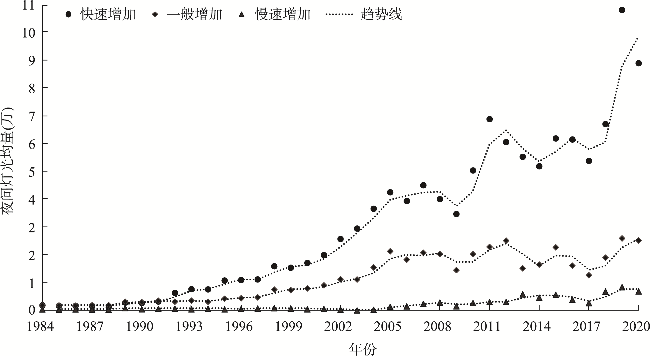
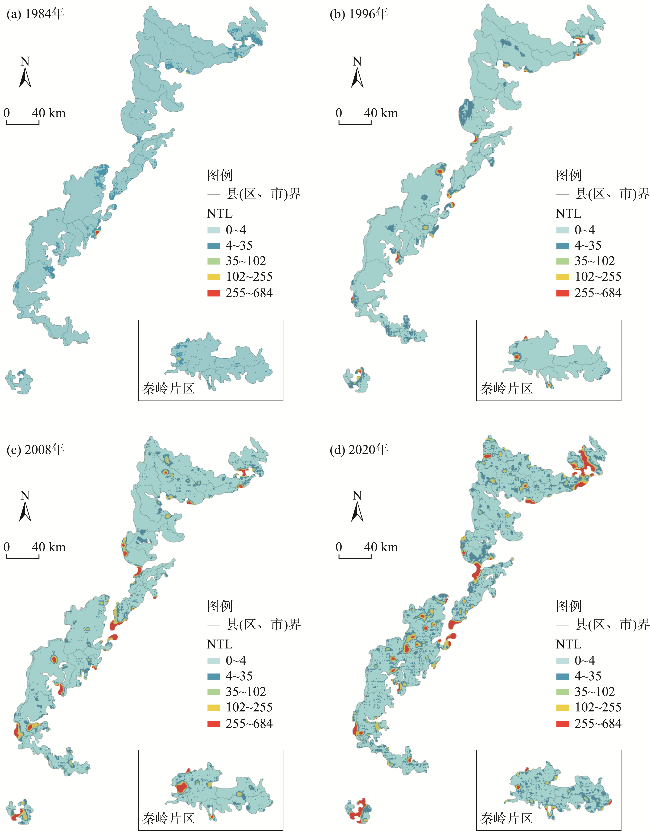
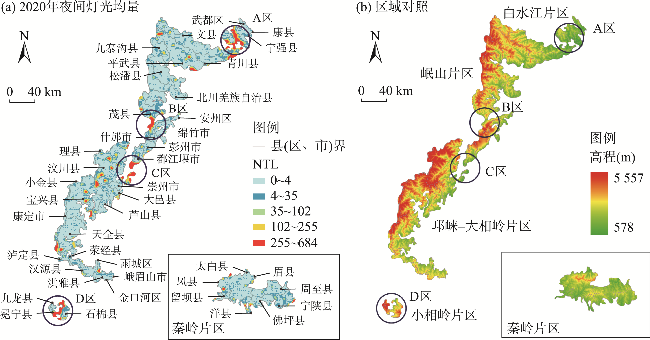
The core purpose of national parks lies in maintaining the integrity of natural ecosystems. Nevertheless, light pollution has become a new challenge currently for natural ecological conservation in national parks. The research takes the Giant Panda National Park as an example. Based on long-term nocturnal light remote sensing data, in combination with the spatial analysis technology of Geographic Information System and the geographical detector method, it explores the spatiotemporal evolution characteristics and influencing factors of light pollution from 1984 to 2020. The research findings indicate that: (1) in terms of temporal evolution, light pollution in the Giant Panda National Park is generally on the rise, with a significantly intensification observed particularly after 2000 and 2008. (2) In terms of spatial differentiation, the pollution exhibits a characteristic pattern of “peripheral agglomeration and core infiltration”, where areas of significant change are concentrated along the fragmented edges of the park, adjacent to major transportation corridors, and near administrative boundaries. (3) In terms of influencing factors, light pollution is driven by the nonlinear interaction of multiple factors. Among them, the gross domestic product is the leading factor, and when it is superimposed with the road network density, the impact reaches its maximum. This research reveals the spatiotemporal evolution patterns and influencing factors of light pollution in the Giant Panda National Park, providing an important reference for the formulation of protection and construction policies for national parks.
表1 数据来源表Tab. 1 Data source table |
| 指标 | 因子 | 数据名称 | 来源 |
|---|---|---|---|
| 夜间灯光数据 | NTL(Y) | 中国长时间序列逐年人造夜间灯光数据集PANDA(1984—2020) | http://data.tpdc.ac.cn |
| 人口密度数据 | POP(X1) | 中国人口空间分布公里网格数据集 | https://www.resdc.cn/ |
| 交通路网数据 | ROAD(X2) | Openstreetmap 2022 | https://www.openstreetmap.org |
| 植被指数数据 | NDVI(X3) | 中国年度植被指数(NDVI)空间分布数据集 | https://www.resdc.cn/ |
| 国内生产总值数据 | GDP(X4) | 中国GDP空间分布公里网格数据集 | https://www.resdc.cn/ |
表2 各区域年际夜间灯光数据变化Mann-kendall检验结果Tab. 2 Results of M-K test on the variation of inter-annual data in each region |
| 趋势 | Z值 | 县(区、市)名称 |
|---|---|---|
| 快速增加 | [6.866, 7.913] | 汶川县、理县、茂县、松潘县、九寨沟县、小金县 |
| 一般增加 | [4.512, 6.003] | 宁陕县、眉县、凤县、太白县、大邑县、都江堰市、彭州市、崇州市、什邡市、绵竹市 |
| 慢速增加 | [2.655, 4.120] | 康定市、泸定县、九龙县、青川县、洋县、宁强县、留坝县、佛坪县、金口河区、峨眉山市、冕宁县、武都区、文县、洪雅县、安州区、北川羌族自治县、平武县、周至县、雨城区、荥经县 |
| 无明显趋势 | [0.445, -1.792] | 汉源县、石棉县、天全县、芦山县 |
| 降低 | -2.289 | 宝兴县 |
表3 分异及因子探测结果Tab. 3 Results of spatial differentiation and factor detection |
| 因子解释结果 | 人口密度(X1) | 路网密度(X2) | 植被指数(X3) | 国内生产总值(X4) |
|---|---|---|---|---|
| q statistic | 0.1388 | 0.0276 | 0.0357 | 0.1793 |
| p value | 0.3803 | 0.9316 | 0.8904 | 0.2671 |
表4 各环境变量交互探测结果Tab. 4 Interactive detection results of environmental variables |
| 驱动因子 | 人口密度(X1) | 路网密度(X2) | 植被指数(X3) | 国内生产总值(X4) |
|---|---|---|---|---|
| 人口密度(X1) | 0.1388 | |||
| 路网密度(X2) | 0.5012 | 0.0276 | ||
| 植被指数(X3) | 0.5553 | 0.2727 | 0.0357 | |
| 国内生产总值(X4) | 0.5421 | 0.6234 | 0.5167 | 0.1793 |
| [1] |
|
| [2] |
|
| [3] |
|
| [4] |
|
| [5] |
|
| [6] |
陈巍巍. 大熊猫国家公园岷山片区生境质量时空变化与生态安全格局构建[D]. 雅安: 四川农业大学, 2023.
[
|
| [7] |
魏明, 冯海亮. 浅谈光污染与人类健康[J]. 灯与照明, 2004, 28(2): 54-56.
[
|
| [8] |
|
| [9] |
郝影, 李文君, 张朋, 等. 国内外光污染研究现状综述[J]. 中国人口·资源与环境, 2014, 24(S1): 273-275.
[
|
| [10] |
|
| [11] |
李德仁, 李熙. 论夜光遥感数据挖掘[J]. 测绘学报, 2015, 44(6): 591-601.
[
|
| [12] |
|
| [13] |
|
| [14] |
|
| [15] |
|
| [16] |
肖练练, 钟林生, 周睿, 等. 近30年来国外国家公园研究进展与启示[J]. 地理科学进展, 2017, 36(2): 244-255.
[
|
| [17] |
秦青, 刘晶茹, 于强, 等. 四川省大熊猫保护地生态安全及其时空演变[J]. 生态学报, 2020, 40(20): 7255-7266.
[
|
| [18] |
徐胜兰. 卧龙自然保护区生态旅游可持续发展模式研究[D]. 成都: 成都理工大学, 2004.
[
|
| [19] |
汪琳, 付潇, 朱创业. 大熊猫国家公园岷山片区生态系统服务价值的时空演变[J]. 湖北农业科学, 2021, 60(15): 44-49.
[
|
| [20] |
姚昕雨, 张茵. 大熊猫国家公园游客参与自然教育的价值共创机理[J]. 中国城市林业, 2023, 21(4): 102-108.
[
|
| [21] |
曾岁康, 林志鹏, 王琦, 等. 物联网与三维GIS在大熊猫智慧国家公园建设中的研究应用[J]. 电力勘测设计, 2023(S1): 97-104.
[
|
| [22] |
向可文. 探索跨省域大熊猫国家公园管理体制和运行机制[J]. 绿色中国, 2020(16): 30-31.
[
|
| [23] |
|
| [24] |
|
| [25] |
|
| [26] |
|
| [27] |
|
| [28] |
高林, 赵中秋, 宋东阳, 等. 1990—2020年北京生态涵养区景观生态风险时空演变及其对自然人为因素的响应研究[J/OL]. 中国环境科学, (2024-02-20). https://doi.org/10.19674/j.cnki.issn1000-6923.20240219.008.
[
|
| [29] |
|
| [30] |
|
| [31] |
彭凯锋, 蒋卫国, 侯鹏, 等. 三江源国家公园植被时空变化及其影响因子[J]. 生态学杂志, 2020, 39(10): 3388-3396.
[
|
| [32] |
|
| [33] |
|
| [34] |
张心语. 城市化背景下郑州都市圈生态系统服务供需时空动态变化及其驱动力研究[D]. 郑州: 河南农业大学, 2023.
[
|
| [35] |
吴绮琦, 蒙吉军. 近40年来黑河流域三生空间格局演变及其驱动因素分析[J]. 北京大学学报(自然科学版), 2023, 59(6): 970-980.
[
|
| [36] |
秦淑洁, 钱天陆, 吴朝宁, 等. 基于地理探测器和最大熵模型的人类出行活动强度空间格局模拟: 以云南省域为例[J]. 地理科学, 2023, 43(8): 1360-1370.
[
|
| [37] |
李江, 吴玉鸣. 空间计量经济学前沿理论、方法与应用研究综述[J]. 当代经济管理, 2024, 46(6): 1-13.
[
|
| [38] |
王劲峰, 徐成东. 地理探测器: 原理与展望[J]. 地理学报, 2017, 72(1): 116-134.
[
|
| [39] |
|
| [40] |
龚明昊, 李志军, 于长青. 西部大开发对四川大熊猫栖息地的影响[J]. 野生动物, 2002, 23(3): 4-6.
[
|
| [41] |
陈玉美, 马月伟, 潘健峰, 等. 大熊猫栖息地干扰因素研究进展[J]. 西南林业大学学报(社会科学), 2022, 6(2): 104-110.
[
|
| [42] |
王爱杰, 张毅, 刘旺财, 等. 青藏高原东北缘文县活动断裂带滑坡发育特征[J]. 自然灾害学报, 2023, 32(3): 239-250.
[
|
| [43] |
黄蜂, 何流洋, 何可, 等. 拖乌山大熊猫廊道人类干扰的空间与时间分布格局: 红外相机阵列调查[J]. 动物学杂志, 2017, 52(3): 403-410.
[
|
| [44] |
田成. 大熊猫栖息地野生动物时空分布及驱动因素研究[D]. 北京: 北京林业大学, 2022.
[
|
| [45] |
杜文武, 眭淼. 自然保护地及其毗邻区人类活动影响研究: 进展与展望[J]. 中国园林, 2023, 39(12): 14-20.
[
|
| [46] |
邓元杰, 海宜峰, 陈航, 等. 四川省国家重点生态功能区生态-经济耦合协调度时空格局与影响因素时空异质性[J/OL]. 环境科学, (2025-04-27) [2025-04-28]. https://doi.org/10.13227/j.hjkx.202411223.
[
|
| [47] |
陆相钱, 沈兴菊. 大熊猫国家公园旅游经营者碳补偿行为影响因素[J]. 自然保护地, 2024, 4(2): 1-19.
[
|
| [48] |
李川北. 大理石矿开发利用项目对大熊猫活动及栖息地的影响[J]. 区域治理, 2020(3): 111-113.
[
|
| [49] |
孙玺, 冯杰. 大熊猫国家公园四川片区集体林经营路径探析[J]. 陕西林业科技, 2023, 51(6): 78-82.
[
|
| [50] |
黄宝荣, 王毅, 苏利阳, 等. 我国国家公园体制试点的进展、问题与对策建议[J]. 中国科学院院刊, 2018, 33(1): 76-85.
[
|
/
| 〈 |
|
〉 |