物候学在旅游地理理论与实践中的应用基础和前景
|
戴君虎(1968-),男,博士,研究员,主要从事植物地理学、植被生态学、物候学和全球变化影响等研究。E-mail: daijh@igsnrr.ac.cn |
收稿日期: 2021-03-05
要求修回日期: 2021-03-25
网络出版日期: 2021-04-28
基金资助
国家重点研发计划项目(2018YFA0606102)
国家自然科学基金项目(41771056)
国家自然科学基金项目(41871033)
版权
Application basis and future perspectives of phenology in the theory and practice of tourism geography
Received date: 2021-03-05
Request revised date: 2021-03-25
Online published: 2021-04-28
Copyright
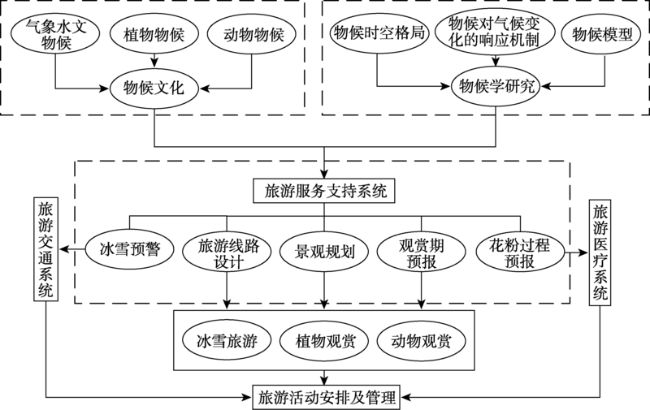
在20世纪80年代应用地理大发展中应运而生的旅游地理学,因发展历程尚短、理论方法体系不十分健全和完善,对持续快速发展的旅游业支撑乏力,迫切需要从相邻学科吸收养分。物候学与旅游地理学交叉性质明显,可多方面支撑其发展。本文系统梳理了物候学对旅游业的学科支撑作用、具体实践应用领域、服务于旅游业高质量发展的6个维度以及气候变化对物候旅游资源和相关行业的影响。主要结论有:(1)物候概念有助于系统整合旅游系统中自然、人文和社会要素的相关旅游资源,而物候学应用亦可有效提升区域旅游业的服务支持子系统、交通子系统以及医疗健康子系统的效用;(2)物候学在旅游业发展中的实践应用主要涉及利用植物季相进行景观设计、观赏季划分与观赏期预报、体验类生态旅游活动的时间规划、花粉浓度预报与冰雪灾情预警以及旅游线路设计五大方面;(3)物候学可在要素、行业、过程、时空、方位和部门6个维度上服务于旅游业的高质量发展;(4)物候旅游资源和相关产业对于气候变化响应敏感,相关研究人员在未来应注重气候变化对其的风险影响研究,深入分析游客感知、行为反应所受影响,并积极参与中长期产业发展规划以及行业报告编制。从学科发展和产业应用的角度讲,物候学可为旅游学的研究提供自然科学的理论支撑,也为当今气候变化背景下旅游业的可持续发展提供科学指导。
戴君虎 , 高新月 , 刘浩龙 , 陶泽兴 , 马翔 , 曹丽娟 . 物候学在旅游地理理论与实践中的应用基础和前景[J]. 中国生态旅游, 2021 , 11(2) : 161 -175 . DOI: 10.12342/zgstly.20210041
Tourism geography, which emerged during the great development of applied geography in the 1980s, cannot now sufficiently support the rapid development of tourist industry due to its short period of development and insufficient theoretical and methodological systems. Therefore, the development of tourist industry urgently needs the knowledge of related more developed disciplines. Phenology is a branch of geography that has an intersection with tourism geography, and it has a very close relationship with tourist industry. The paper systematically reviews the role of phenology in supporting the tourism system, its applications in five specific industrial fields, the role in promoting six dimensions of the high-quality development of tourism, and the influence of climate change on phenological tourism resources and related industries. The analysis shows that: (1) The concept of phenology can help to integrate the tourism resources of natural, human, and social elements in the tourism system. The application of phenology in the tourism industry can effectively improve the service support sub-systems, transportation sub-systems, and medical and health sub-system. (2) The practical application of phenology in the tourist industry mainly involves plant landscape design, determination of ornamental tourism season, ornamental phenology forecasting, time planning for eco-tourism activities, pollen concentration forecasting, ice and snow disaster warning, and tourist route design. (3) Phenology supports six dimensions of high-quality development of tourism, including element, industry, process, time and space, direction, and participating sector. (4) Phenological tourism resources and related industrial links are sensitive to climate change. In the future, studies should focus on the risks of climate change in different climate scenarios and in-depth analysis of the influences on the perceptions and behavior of tourists. Phenological change should be integrated into medium and long-term industrial development plans and industry reports. From the perspectives of disciplinary development and industrial application, phenology can provide theoretical basis for tourism research, as well as practical guidance for the sustainable development of tourism in the context of climate change.
| [1] |
2019年旅游市场基本情况. https://www.mct.gov.cn/whzx/whyw/202003/t20200310_851786.htm[EB/OL]. 2020-3-10.
[Basic information of the tourism market in 2019. https://www.mct.gov.cn/whzx/whyw/202003/t20200310_851786.htm[EB/OL]. 2020-3-10.]
|
| [2] |
|
| [3] |
|
| [4] |
李文静, 张朝枝. 过程研究转向: 旅游地理研究的理论建构新视角[J]. 旅游导刊, 2019,3(002):19-39.
[
|
| [5] |
张潇, 陆林, 徐雨晨. 基于《Tourism Geographies》的近十年国外旅游地理研究进展[J]. 人文地理, 2019,34(6):26-34+109.
[
|
| [6] |
竺可桢 等, 物候学[M]. 北京: 科学出版社, 1973.
[
|
| [7] |
保继刚, 楚义芳, 旅游地理学[M]. 高等教育出版社, 1999.
[
|
| [8] |
吴必虎, 旅游规划原理[M]. 北京: 中国旅游出版社, 2010.
[
|
| [9] |
张明庆, 杨国栋. 旅游物候课程设计[J]. 首都师范大学学报(自然科学版), 2006,27(1):73-74.
[
|
| [10] |
GB/T 18972-2017, 旅游资源分类、调查与评价[S]. 北京: 中国标准出版社, 2017.
[ Classification, investigation and evaluation of tourism resources. Beijing: Standards Press of China, 2017.]
|
| [11] |
叶清, 焦庚英, 许晓利, 等. 物候学在植物季相景观规划中的应用[C]. 全国农业气象与生态环境学术年会论文集, 2006.
[
|
| [12] |
苏雪痕. 植物造景[M]. 北京: 中国林业出版社, 1994.
[
|
| [13] |
荆丹娟. 季节性景观规划设计研究[D]. 南京: 南京林业大学, 2006.
[
|
| [14] |
刘滨谊, 余畅. 美国绿道网络规划的发展与启示[J]. 中国园林, 2001(6):77-81.
[
|
| [15] |
张晓燕, 李宝丰. 布查花园的种植设计解析及其启示[J]. 风景园林, 2006(2):24-27.
[
|
| [16] |
田至美. 山地生态旅游资源特点和开发途径——以北京山区为例[J]. 资源·产业, 2005,7(1):42-45.
[
|
| [17] |
孙峰梅. 中国古典园林植物配置对现代园林设计的启发[J].现代园艺, 2015(10):151.
[
|
| [18] |
刘少宗, 园林植物造景(上册)景观设计纵论[M]. 天津: 天津大学出版社, 2003.
[
|
| [19] |
陈效逑, 曹志萍. 植物物候期的频率分布型及其在季节划分中的应用[J]. 地理科学, 1999,19(1):21-27.
[
|
| [20] |
杨国栋, 陈效逑. 木本植物物候相组合分类研究——以北京市植物园栽培树种为例[J]. 林业科学, 2000,36(2):39-46.
[
|
| [21] |
张明庆, 杜育林, 任阳. 北京什刹海地区的物候季节[J]. 首都师范大学学报(自然科学版), 2007(3):78-80.
[
|
| [22] |
邢小艺, 郝培尧, 李冠衡, 等. 北京植物物候的季节动态特征——以北京植物园为例[J]. 植物生态学报, 2018,42(9):906-916.
[
|
| [23] |
许涵, 王晓明, 崔大方. 深圳莲花山公园景观植物物候特点及对公园景观的影响[J]. 华南农业大学学报, 2004,25(2):80-84.
[
|
| [24] |
谷爱珍. 植物物候相在植物季相景观设计中的应用——以呼和浩特市40种园林树木为例[D]. 呼和浩特: 内蒙古农业大学 2011.
[
|
| [25] |
康秀琴. 秋季植物季相景观与景观特色分析——以桂林地区为例[J]. 韶关学院学报, 2018,39(06):76-80.
[
|
| [26] |
何丽芳. 关于发展赏花经济的思考[J]. 北方经贸, 2014(9):255-257.
[
|
| [27] |
|
| [28] |
高新月, 戴君虎, 张明庆. 1965-2014年北京西郊地区植物观赏期对气候变化的响应[J]. 地理研究, 2018,37(12):2420-2432.
[
|
| [29] |
|
| [30] |
|
| [31] |
陶泽兴, 葛全胜, 王焕炯, 等. 中国中东部植被景观观赏季划分的物候学基础[J]. 地理学报, 2015,70(01):85-96.
[
|
| [32] |
戴君虎, 陶泽兴, 王焕炯, 等. 物候模型在气候定量重建中的应用[J]. 第四纪研究, 2016,36(3):702-710.
[
|
| [33] |
|
| [34] |
|
| [35] |
|
| [36] |
|
| [37] |
张爱英, 王焕炯, 戴君虎, 等. 物候模型在北京观赏植物开花期预测中的适用性[J]. 应用气象学报, 2014,25(4):483-492.
[
|
| [38] |
尹志聪, 袁东敏, 丁德平, 等. 香山红叶变色日气象统计预测方法研究[J]. 气象, 2014,40(2):229-233.
[
|
| [39] |
张增信, 王言鑫, 杨艳蓉, 等. 南京地区8种常见观赏树木花期可预报研究[J]. 生态科学, 2014,33(04):642-648.
[
|
| [40] |
张爱英, 张建华, 高迎新, 等. SW物候模型在北京樱花始花期预测中的应用[J]. 气象科技, 2015,43(2):309-313.
[
|
| [41] |
仲舒颖, 葛全胜, 戴君虎, 等. 中国典型观赏植物花期模型建立及过去花期变化模拟[J]. 资源科学, 2017,11(39):102-115.
[
|
| [42] |
陈冰, 宋祖钦, 彭荣南, 等. 化橘红始花期与气象因子的相关分析及预报模型[J]. 中国农学通报, 2019,35(10):104-107.
[
|
| [43] |
陈玉萍, 刘嘉毅, 郭修金. 基于网络关注度的中国冰雪旅游产业发展启示[J]. 天津体育学院学报, 2020,35(05):519-524.
[
|
| [44] |
|
| [45] |
常晓铭, 刘卫国. "一带一路"背景下北京冬奥会推动我国冰雪旅游产业融合发展研究[J]. 北京体育大学学报, 2020,43(7):91-101.
[
|
| [46] |
中国冰雪旅游发展报告[R]. 中国旅游研究院, 2021.
[Ice and snow tourism development report of China[R]. China Tourism Academy, 2021]
|
| [47] |
|
| [48] |
肖乾丽, 杨建美,
[
|
| [49] |
付蓉, 王曼娜, 杨鹛, 等. 洞庭湖观鸟旅游发展现状及对策[J]. 经济地理, 2008,28(3):523-526.
[
|
| [50] |
|
| [51] |
叶世泰, 张金谈, 乔秉善, 等中国气传和致敏花粉[M]. 北京: 科学出版社, 1988.
[
|
| [52] |
欧阳昱晖. 中国北方夏秋季致敏花粉种属和浓度分析[J]. 中国耳鼻咽喉头颈外, 2020,27(04), 184-187.
[ Ouyangyuhui. Analysis of pollen species and concentration in summer and autumn in northern China[J]. Chinese Archives of Otolaryngology-Head and Neck Surgery, 2020,27(04), 184-187.]
|
| [53] |
龙隆, 赵显莉, 谭红, 等. 飘散致敏花粉与大气颗粒物研究进展[J]. 环境科学与技术, 2017,040(012):112-118.
[
|
| [54] |
马丽君, 孙根年, 马耀峰, 等. 极端天气气候事件对旅游业的影响——以2008年雪灾为例[J]. 资源科学, 2010(01):107-112.
[
|
| [55] |
席建超. 旅游景区安全管理[M]. 北京: 旅游教育出版社, 2015.
[
|
| [56] |
韩超, 丁德平, 李讯. 中国物候季节时空分布规律研究[C]. 中国气象学会2008年会论文集. 北京, 中国气象学会, 2008: 18-24.
[
|
| [57] |
李志刚. 以高质量发展提升旅游业整体竞争力——旅游业界热议中央经济工作会议[N]. 中国旅游报, 2019-12-17.
[
|
| [58] |
|
| [59] |
吴普, 席建超, 葛全胜. 中国旅游气候学研究综述[J]. 地理科学进展, 2010,29(02):131-137.
[
|
| [60] |
|
| [61] |
|
| [62] |
|
| [63] |
|
| [64] |
徐韵佳, 仲舒颖, 戴君虎, 等. 1978-2014年牡丹江地区植物花期变化及模型模拟[J]. 地理研究, 2017,036(004):779-789.
[
|
| [65] |
陶泽兴, 仲舒颖, 葛全胜, 等. 1963-2012年中国主要木本植物花期长度时空变化[J]. 地理学报, 2017,72(01):53-63.
[
|
| [66] |
|
| [67] |
|
| [68] |
刘俊, 黄莉, 孙晓倩, 等. 气候变化对中国观鸟旅游的影响——基于鸟类物候变化的分析[J]. 地理学报, 2019,74(5):912-922.
[
|
| [69] |
|
| [70] |
|
| [71] |
马丽, 方修琦. 近20年气候变暖对北京时令旅游的影响——以北京市植物园桃花节为例[J]. 地球科学进展, 2006(03):97-103.
[
|
| [72] |
|
| [73] |
刘俊, 李云云, 刘浩龙, 等. 气候变化对成都桃花观赏旅游的影响与人类适应行为[J]. 地理研究, 2016,35(03):106-114.
[
|
| [74] |
|
| [75] |
|
/
| 〈 |
|
〉 |