Spatial correlation pattern of “distance-agglomeration” of urban tourism industry factors
Received date: 2024-04-01
Revised date: 2024-06-10
Online published: 2024-09-18
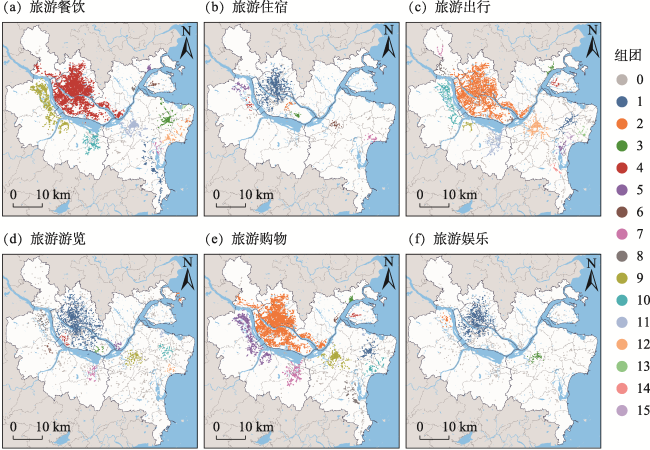
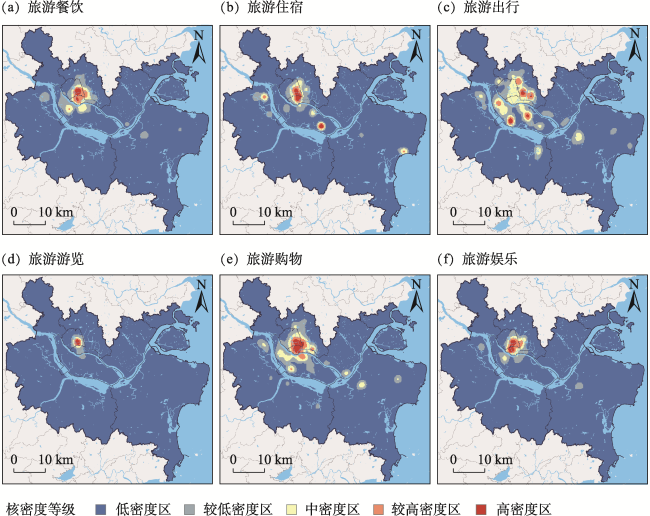
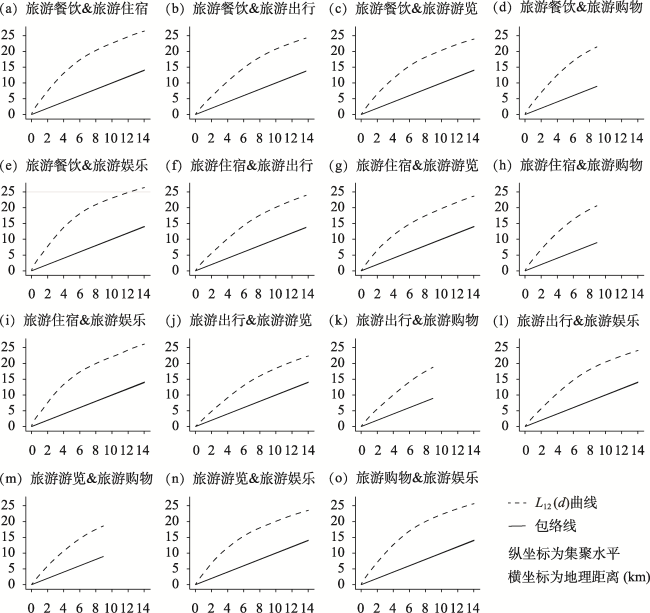
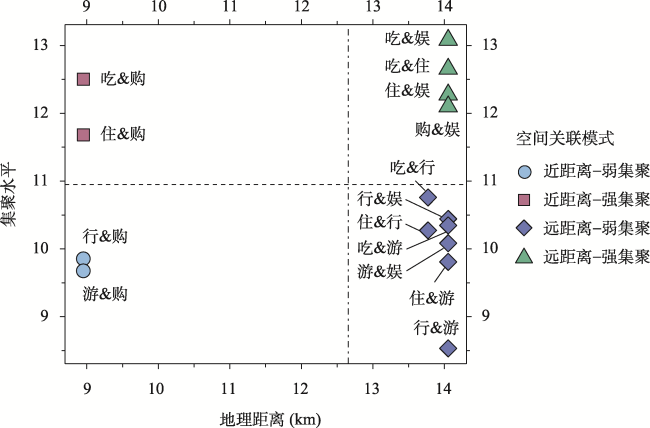
The complexity of urban functions and structure brings new challenges to the spatial layout of tourism industry factors. This study focuses on the main urban area of Fuzhou City and examines the spatial distribution of the six factors of the tourism industry: catering, accommodation, transportation, sightseeing, shopping, and entertainment. Bivariate Ripley’s K function is introduced to reveal the “distance-agglomeration” correlation pattern among these factors. The results show that: (1) the spatial distribution density of the six factors of the tourism industry has a strong correlation with the urban functional zoning, and the pattern of the six factors shows the distribution characteristics of “along the river, large agglomeration and small dispersion”, and forms multiple spatial clusters. (2) The agglomeration hotspots distribution of the six factors of tourism industry has spatial commonality and heterogeneity. The hotspots of catering, shopping, and entertainment factors demonstrate strong spatial correlations, while sightseeing hotspots tend to have a mono-core distribution. Transportation hotspots have a broader distribution range, and accommodation hotspots have a strong tourist flow and transportation orientation. (3) The study identifies four types of “distance-agglomeration” spatial correlation patterns among the six factors of the tourism industry. The patterns include “close distance-strong agglomeration” and “close distance-weak agglomeration”, with the shopping factors at the center. The “long distance-weak agglomeration” pattern is associated with transportation and sightseeing factors, while the “long distance-strong agglomeration” model is centered on entertainment factors. This analysis offers a deepen spatial understanding of the relationships between different factors of the tourism industry.
Zhang Kun , Xie Chaowu . Spatial correlation pattern of “distance-agglomeration” of urban tourism industry factors[J]. ECOTOURISM, 2024 , 14(3) : 621 -635 . DOI: 10.12342/zgstly.20240107
表1 旅游产业要素类型与基本载体Tab. 1 Types and basic carriers of tourism industry factors |
| 类别 | 基本载体 | 数量(个) |
|---|---|---|
| 旅游餐饮(吃) | 小吃店、快餐店、中餐馆、西餐馆、咖啡厅、茶座、奶茶店、蛋糕甜品店等 | 31 625 |
| 旅游住宿(住) | 民宿、旅馆、青旅、经济型酒店、三星级酒店、四星级酒店、五星级酒店等 | 2 078 |
| 旅游出行(行) | 公交站、长途汽车站、地铁站、火车站、轮渡港口、机场、充电站、加气站、 加油站、汽车维修店、汽车配件店、汽车租赁公司等 | 5 729 |
| 旅游游览(游) | A级旅游景区、博物馆、纪念馆、科技馆、天文馆、图书馆、文化宫、会展展览 场馆、一般景点、宗教寺庙、城市公园、植物园、动物园、水族馆、露营地等 | 3 402 |
| 旅游购物(购) | 百货商场、购物中心、便利店、商业街、旅游纪念品店、超市、免税店等 | 13 561 |
| 旅游娱乐(娱) | 农家乐、度假养老基地、游乐场、电影院、剧场、音乐厅、KTV、酒吧、棋牌室等 | 1 735 |
表2 福州市主城区旅游产业要素密度分布Tab. 2 Density distribution of tourism industry factors in the urban area of Fuzhou City |
| 区(县) | 旅游餐饮 | 旅游住宿 | 旅游出行 | 旅游游览 | 旅游购物 | 旅游娱乐 | 整体密度 |
|---|---|---|---|---|---|---|---|
| 台江区 | 243.91 | 16.41 | 18.52 | 10.78 | 96.45 | 15.74 | 401.83 |
| 鼓楼区 | 148.28 | 10.59 | 12.44 | 18.84 | 48.27 | 9.21 | 247.64 |
| 仓山区 | 54.33 | 3.41 | 9.85 | 4.09 | 23.52 | 2.21 | 97.41 |
| 晋安区 | 41.44 | 2.17 | 7.81 | 3.55 | 17.57 | 2.23 | 74.78 |
| 闽侯县 | 6.37 | 0.48 | 1.40 | 0.62 | 2.84 | 0.36 | 12.08 |
| 马尾区 | 5.61 | 0.21 | 1.64 | 0.91 | 3.23 | 0.35 | 11.96 |
| 长乐区 | 5.22 | 0.41 | 1.64 | 1.07 | 2.65 | 0.31 | 11.31 |
| 连江县 | 2.19 | 0.12 | 0.64 | 1.90 | 1.95 | 0.22 | 7.02 |
表3 旅游产业要素HDBSCAN聚类组团分布Tab. 3 The distribution of HDBSCAN cluster group of tourism industry factors |
| 类别 | HDBSCAN聚类组团 | |||||||||||||||
|---|---|---|---|---|---|---|---|---|---|---|---|---|---|---|---|---|
| 0 | 1 | 2 | 3 | 4 | 5 | 6 | 7 | 8 | 9 | 10 | 11 | 12 | 13 | 14 | 15 | |
| 旅游餐饮 | 0.98 | 1.88 | 0.14 | 2.22 | 72.71 | 0.40 | 0.33 | 0.24 | 0.36 | 11.62 | 2.71 | 4.74 | 1.58 | 0.11 | - | - |
| 旅游住宿 | 15.06 | 52.33 | 4.28 | 7.17 | 2.79 | 9.52 | 2.69 | 6.16 | - | - | - | - | - | - | - | - |
| 旅游出行 | 11.59 | 2.53 | 58.81 | 0.75 | 0.54 | 1.08 | 0.38 | 0.87 | 1.03 | 1.22 | 6.49 | 5.92 | 6.13 | 1.17 | 0.73 | 0.75 |
| 旅游游览 | 30.29 | 49.03 | 0.91 | 1.06 | 1.41 | 2.06 | 1.24 | 1.94 | 3.03 | 4.54 | 2.42 | 0.94 | 1.12 | - | - | - |
| 旅游购物 | 3.38 | 2.96 | 69.68 | 0.80 | 0.46 | 10.51 | 0.44 | 3.75 | 1.39 | 5.04 | 1.36 | 0.22 | - | - | - | - |
| 旅游娱乐 | 31.28 | 59.50 | 4.15 | 5.07 | - | - | - | - | - | - | - | - | - | - | - | - |
注:单元格内的数值为该组团内旅游产业要素占比(%);-表示不存在该组团。 |
表4 旅游产业要素全局空间自相关检验Tab. 4 Global spatial autocorrelation test of tourism industry factors |
| 指标 | 旅游餐饮 | 旅游住宿 | 旅游出行 | 旅游游览 | 旅游购物 | 旅游娱乐 |
|---|---|---|---|---|---|---|
| Moran’s I | 0.409 | 0.112 | 0.322 | 0.151 | 0.375 | 0.403 |
| SD | 0.071 | 0.067 | 0.074 | 0.076 | 0.072 | 0.073 |
| p值 | 0.000 | 0.058 | 0.000 | 0.029 | 0.000 | 0.000 |
真诚感谢匿名审稿专家以及编辑部老师在论文评审过程中付出的时间和精力,专家对研究概念明晰、逻辑思路、结果呈现等方面的修改意见,获益匪浅,特此感谢!
| [1] |
黄震方, 黄睿, 葛军莲. 中国式现代化理论视角的旅游地理研究: 科学问题与学术使命[J]. 经济地理, 2023, 43(5): 16-25.
[
|
| [2] |
虞虎. 大都市传统工业区休闲旅游转型对城市功能演化的影响[J]. 经济地理, 2016, 36(11): 214-223.
[
|
| [3] |
王朝辉, 陆林, 方婷, 等. 世博建设期上海市旅游住宿产业空间格局演化[J]. 地理学报, 2012, 67(10): 1423-1437.
[
|
| [4] |
李柏文. 新时代旅游产业体系的特征与建设[J]. 旅游学刊, 2018, 33(10): 7-9.
[
|
| [5] |
戴斌, 束菊萍. 旅游产业关联: 分析框架与北京的实证研究[J]. 北京第二外国语学院学报, 2005, 27(5): 7-15.
[
|
| [6] |
孙九霞, 李菲, 王学基. “旅游中国”: 四十年旅游发展与当代社会变迁[J]. 中国社会科学, 2023(11): 84-104, 206.
[
|
| [7] |
邹光勇, 刘明宇, 刘鹏, 等. 公共景区门票价格管理理论述评: 基于国际比较视角[J]. 旅游学刊, 2021, 36(6): 60-73.
[
|
| [8] |
周素红, 邓丽芳. 基于T-GIS的广州市居民日常活动时空关系[J]. 地理学报, 2010, 65(12): 1454-1463.
[
|
| [9] |
虞虎, 刘青青, 陈田, 等. 都市圈旅游系统组织结构、演化动力及发展特征[J]. 地理科学进展, 2016, 35(10): 1288-1302.
[
|
| [10] |
宁志中, 王婷, 杨雪春. 2001年以来中国旅游景区时空格局演变与景区群形成[J]. 地理研究, 2020, 39(7): 1654-1666.
[
|
| [11] |
孙景荣, 张捷, 章锦河, 等. 中国区域旅行社业效率的空间分异研究[J]. 地理科学, 2014, 34(4): 430-437.
[
|
| [12] |
|
| [13] |
任国岩. 长三角会展场馆空间集聚特征及影响因素[J]. 经济地理, 2014, 34(9): 86-92.
[
|
| [14] |
|
| [15] |
贾文通, 黄震方, 洪学婷, 等. 共享民宿空间集聚特征及其影响机制研究: 以北京市Airbnb为例[J]. 中国生态旅游, 2021, 11(5): 751-766.
[
|
| [16] |
厉新建, 殷婷婷, 李姗, 等. 中国露营地空间分布及其影响机制[J]. 经济地理, 2023, 43(5): 205-218.
[
|
| [17] |
蒋依依, 邓宁, 高秉博, 等. 地球信息科学在旅游休闲领域研究的辩证审视[J]. 地球信息科学学报, 2024, 26(2): 227-241.
[
|
| [18] |
李莉, 侯国林, 夏四友, 等. 成都市休闲旅游资源空间分布特征及影响因素[J]. 自然资源学报, 2020, 35(3): 683-697.
[
|
| [19] |
肖博鸿, 马源. 广州历史街区旅游要素空间分布与交通可达性关联研究[J]. 经济地理, 2024, 44(4): 231-240.
[
|
| [20] |
李维维, 马晓龙. 中国大城市旅游休闲业态的空间格局研究: 西安案例[J]. 人文地理, 2019, 34(6): 153-160.
[
|
| [21] |
李亚娟, 罗雯婷, 王靓, 等. 城市旅游休闲热点区演变特征及驱动机制研究: 以武汉市为例[J]. 人文地理, 2021, 36(1): 183-192.
[
|
| [22] |
唐鸿, 许春晓. 长沙市休闲旅游资源空间分布特征及形成机制[J]. 经济地理, 2022, 42(12): 214-223.
[
|
| [23] |
杜志强, 李钰. 旅游产业空间分布及关联性分析方法: 以常州市为例[J]. 地理信息世界, 2019, 26(3): 25-30.
[
|
| [24] |
万红莲, 王晓利, 黄敏, 等. 基于POI数据的关中平原城市群县域旅游要素空间格局及影响因素研究[J]. 干旱区资源与环境, 2024, 38(6): 200-208.
[
|
| [25] |
吴雪琴, 胡伟平, 巫细波. 空间关联视角下广州市餐饮业空间分布特征及影响因素研究[J]. 地球信息科学学报, 2023, 25(11): 2232-2248.
[
|
| [26] |
|
| [27] |
|
| [28] |
余颖, 刘青, 李贵才. 深圳高新电子信息企业空间格局演化及其影响因素[J]. 世界地理研究, 2020, 29(3): 557-567.
[
|
| [29] |
湛东升, 孟斌. 基于社会属性的北京市居民居住与就业空间集聚特征[J]. 地理学报, 2013, 68(12): 1607-1618.
[
|
| [30] |
刘小恺, 刘茂松, 黄峥, 等. 宁夏沙湖4种干旱区群落中主要植物种间关系的格局分析[J]. 植物生态学报, 2009, 33(2): 320-330.
[
|
| [31] |
|
| [32] |
|
| [33] |
时姗姗, 席建超. 青藏高原旅游城镇化测度研究[J]. 地理研究, 2024, 43(2): 377-393.
[
|
/
| 〈 |
|
〉 |